It’s Time to Open Your Hand Again. Dupuytren’s Contracture is a progressive condition that can rob you of the ability to straighten your fingers, making simple daily tasks increasingly difficult. We offer both minimally invasive (Needle Aponeurotomy) and open surgery (palmar fasciectomy) solutions to release the contracture, straighten your fingers, and restore your hand’s function. What is Dupuytren’s Contracture? Body Copy: Dupuytren’s […]
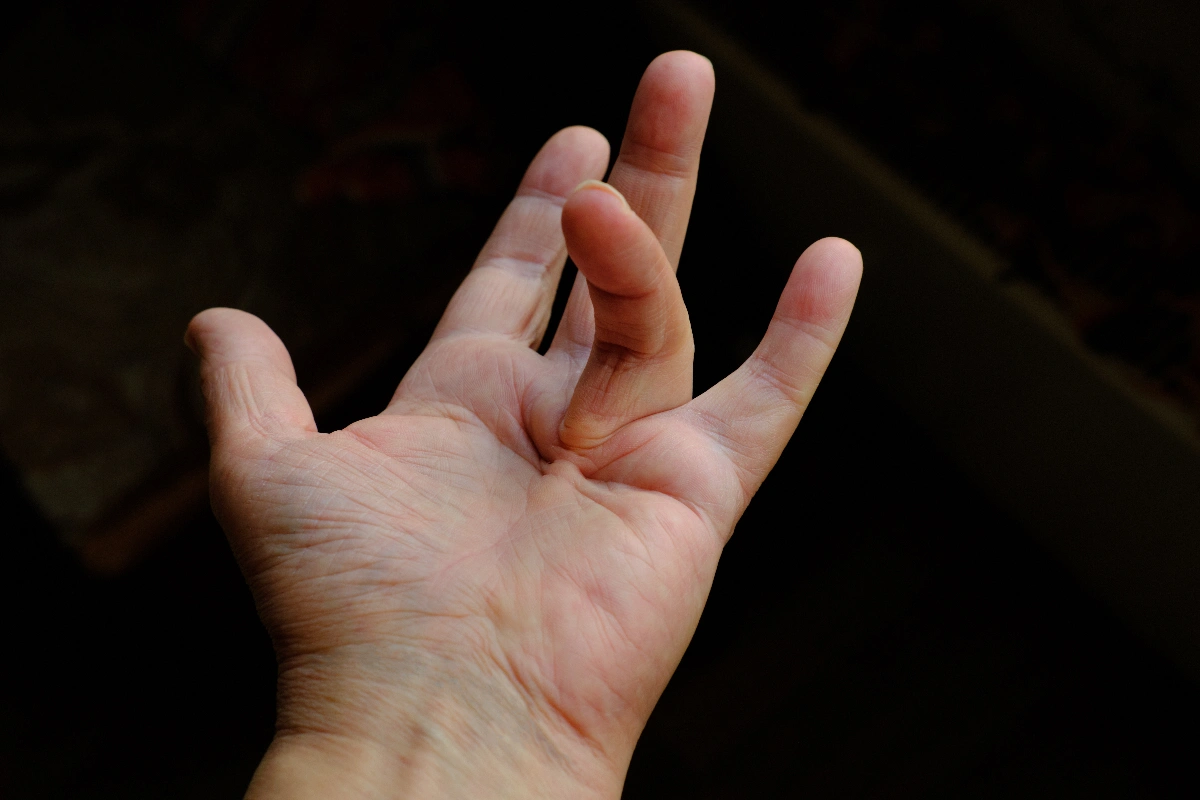
Dupuytren’s Contracture is a progressive condition that can rob you of the ability to straighten your fingers, making simple daily tasks increasingly difficult. We offer both minimally invasive (Needle Aponeurotomy) and open surgery (palmar fasciectomy) solutions to release the contracture, straighten your fingers, and restore your hand’s function.
Body Copy: Dupuytren’s Contracture is a benign (non-cancerous) condition that affects a layer of tissue called the fascia that lies under the skin of your palm. For reasons that are not fully understood, this fascia begins to thicken and tighten, forming firm lumps and rope-like cords. Over time, these cords can progressively pull your fingers—most commonly the ring and small fingers—into a bent position, making it impossible to fully open your hand.
The decision to have a procedure for Dupuytren’s is based on function. A simple guide is the “tabletop test”: if you are unable to place your hand completely flat on a table, the contracture is likely advanced enough to be causing functional problems. When the condition begins to interfere with daily activities—such as washing your face, shaking hands, or putting on gloves—it is time to consider a definitive surgical solution.
Initially pioneered by dermatologist Dr. Claude Lemersieux at the Hôtel Dieu Hospital in Paris in the 1990’s, NA has become a preferred treatment by patients, especially those who have had previous open surgery in the form of a palmar fasciectomy. Dr. French travelled to Paris in 2009 to train in the technique and NA has become the workhorse procedure of choice for most patients with Dupuytren’s. The open surgery that is done under a general anesthetic can result in extensive scarring, complications of bleeding, nerve injury, and stiffness, and requires many, many months of hand therapy to recover. fi
How it works: NA is done under local anesthetic where a series of release points along each cord are frozen with a microscopic amount of anesthetic, just enough to painlessly allow a slightly larger needle to be passed through the skin and into the Dupuytren cord. At each NA site, the cord is completely cut using the tip of the needle while tension is applied to the finger. No stitches are required, only small band-aids over the needle sites. The fingers are straightened on the table with immediate results. Patients may wash and dry the hand normally that night and aside from some temporary bruising the next day, recovery is only 24-48 hours. A custom splint to hold the fingers in extension at nighttime only for the first 6 months is fashioned by a certified hand therapist at a convenient time in the first 2-3 days. The one disadvantage of the NA technique is that recurrence will occur because the Dupuytren’s tissues have not been completely removed. Recurrence rates are noted in the medical literature at 66% of patients at 4-years after NA.
Body Copy: For centuries, the only real option was a surgical treatment called a Fasciectomy. The goal of this procedure is to surgically remove the diseased tissue and allow the finger to straighten. This has largely been supplanted by the Needle Aponeurotomy since palmar fasciectomy has higher complication rates and a much longer recovery. The advantage of this age-old technique, however, is the prevention of recurrence. Because all of the Dupuytren’s affected tissues are completely removed at the time of surgery, the disease cannot recur in those areas. It may begin in other areas that were previously unaffected but when meticulously and completely removed with a palmar fasciectomy, Dupuytren’s will rarely ever recur in those areas.
How it works: Dr. French makes precise incisions over the cord in the palm and finger. He then meticulously dissects and removes all of the diseased cords of fascia, taking great care to protect the delicate nerves and tendons that are often intertwined with them. Once the restricting cords are removed, the finger can be straightened. The skin overlying the cords will have shrunk down over time and to close the incisions, a series of plastic surgical flaps know as Z-plasties are designed to move the skin around to close the incision under no tension and with sufficient skin to prevent contacture of the scars.
The cords of Dupuytren’s are not simple structures; they are often wrapped around the tiny, critical nerves and tendons that control finger sensation and movement. Whether releasing the cords with the NA technique or safely removing these cords surgically without damaging the underlying structures are delicate and demanding tasks. Dr. French’s expertise as a Harvard-trained reconstructive plastic surgeon and microsurgeon enables him to perform this meticulous dissection, ensuring a safe and effective outcome for your hand. He also trained in Paris with the originators of the NA technique in 2009 and has performed well over a thousand successful NA procedures since then.